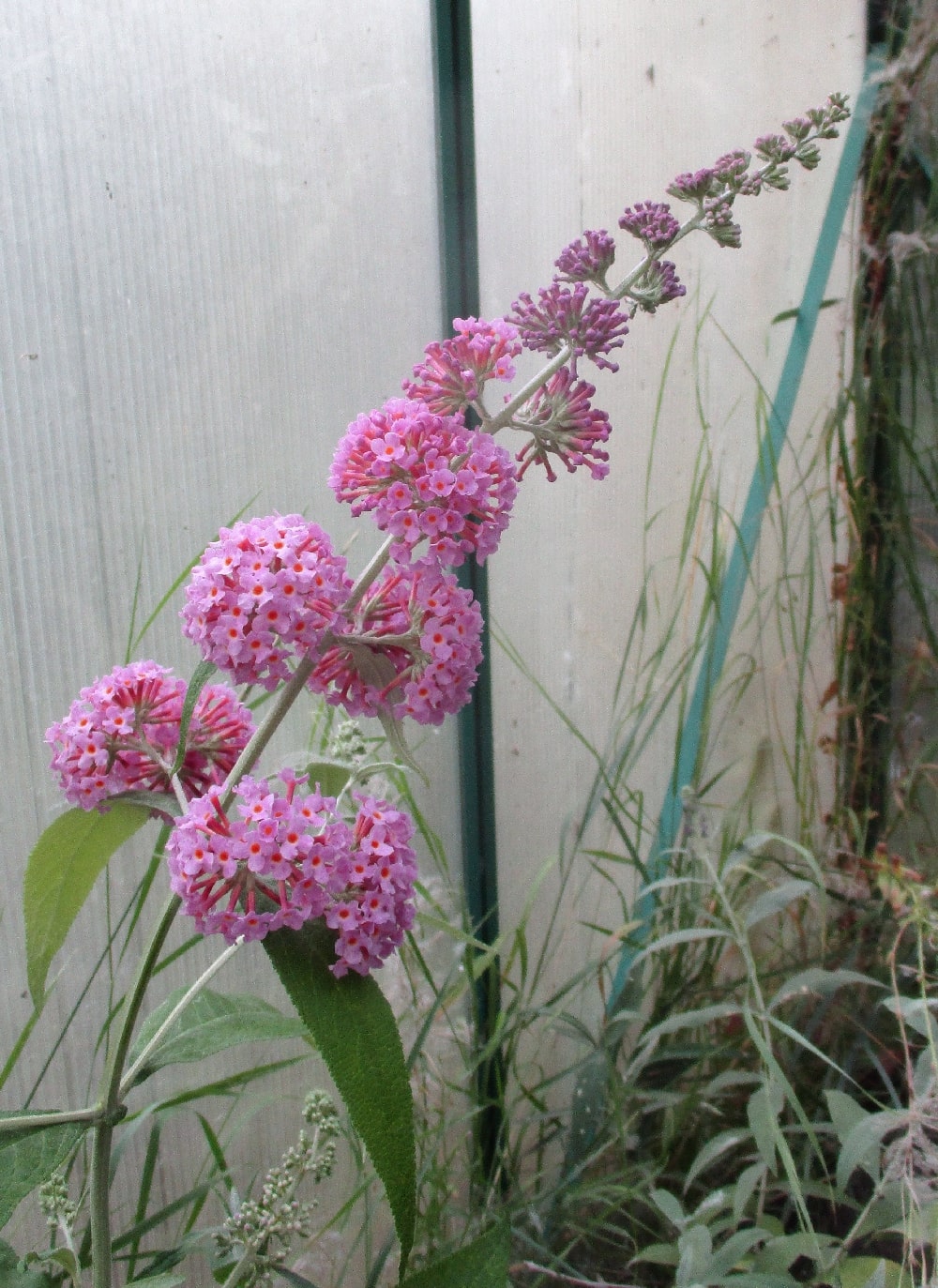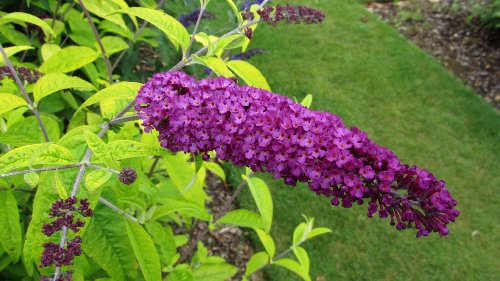

A Buddleja macrostachya with Mauve Flowers

22nd October 2025

After a difficult year of aphids and drought, it's nice to end the season on a positive note.

A Thousand Flowers is an excellent nursery near Seattle (Washington, USA) with a good selection of Buddlejas. The owner very kindly sent me some seeds, including some from his own Buddleja macrostachya specimen. I grew on a few seedlings and a couple are flowering in only their second year; these larger species can be shy to bloom for the first time.

B. macrostachya is often self-fertile and I am confident this seedling is not a hybrid. The flowers are finer compared to others of the species, but have the stamens in the throat and a tomentose exterior to the corolla tubes, typical for the species. The panicles are upright and it has flowered late in the year, so I would consider this a 'Type 2' B. macrostachya. ('Type 1' are those which flower August and have pendulous panicles, see the forrestii and macrostachya page.) The leaves of this species are very variable, and those of this plant are large, but less fleshy compared to others.

The colour the flower is good, a strong mauve with a very red eye, and the panicle is well stocked with flowers. This plant will be spending the winter in a cool greenhouse as I don't know its hardiness and can't predict what sort of winter we will have. However, I will eventually plant it outside.

The B. macrostachya flowers up close
Open full size image in a new window


This B. macrostachya inflorescence is upright
Open full size image in a new window


B. davidii var. nanhoensis

20th August 2025

Buddleja davidii var nanhoensis was once treated as a full subspecies (or variety), but under current taxonomy is no more than a cultivar. The plant we grow came from seen collected by the famous plant hunter Reginald Farrer in 1914 in the Gansu province of western China (see the original report here, described as B. variabilis var nanhoensis Chittenden). The seeds were grown at the RHS Garden, Wisley. The flowers of the surviving 'Nanho' plant are a pleasant pale-pinky lilac and the leaves narrow. Several varieties have been bred from this form to take advantage of its more delicate foliage and showy flowers: 'Nanho Blue'; 'Nanho Purple'; 'Nanho White'; and quite possibly 'Glasnevin Hybrid' as well.

Ref: F.J. Chittenden, Journ. Roy. Hort. Soc. (1922) vol 47, pp193.


The B. davidii var. nanhoensis inflorescence
Open full size image in a new window


A Different Flower

17th August 2025

I've grown any number of plants from the seeds of the B. × weyeriana hybrids in the hope of producing a unique type of flower. Some of the results have been promising, and many of the plants of this type are seed sterile. One that I've called 'Pink Sundae' is particularly noteworthy, with its unique pink-flushed cream flowers, and something I've been trying to repeat. This year's batch has thrown up one particularly interesting inflorescence.

This flower has pale, yellowish flowers emerging from bright mauve buds. The effect is very different from any other Buddleja flower and quite striking. I've kept the plant out of the most searing sun and heat, as this can alter the flower pigments. Hopefully, this is a genuine colour combination and not influenced by our current aberrant weather. However, I won't get too excited, as these B. × weyeriana seedlings are not always completely stable and next year the flower could be more mundane. And it's almost certainly going to prove sterile, so something of a dead-end.


This B. × weyeriana seedling has almost yellow flowers emerging from bright mauve buds
Open full size image in a new window


Yes, yet more small Buddlejas:
BABY BUZZ®

24th July 2025

Unbelievably, the torrent of new diminutive Buddleja continues. This time it's a series called BABY BUZZ®. These are from PlantHaven International in the USA, bred by Scott C. Trees (Arroyo Grande, CA). They are not related to the original BUZZ® plants from Thompson and Morgan, who abandoned their plant breeding programme several years ago.

This new series makes the claim to be the first hanging basket Buddlejas, although the 'DREAMING' plants ('Hinebud1', 'Hinebud3' and 'Hinebud4') predate BABY BUZZ® by a decade.

There are three colours so far: Purple (shown), Pink and Lipstick Pink. They have a prostrate, spreading habit, and supposedly grow only 20cm tall but up to metre wide. I believe they will prove to be container-only plants, and I certainly found the similar 'DREAMING' plants rotted off almost immediately when planted at soil level.


Photo: © Plant Haven, California, USA.


Another flower with large eyes

23rd July 2025

Ever since I started breeding Buddlejas, I have been trying to perfect a type of flower with a white ring around the yellow-orange throat in the centre. I've lost count of the number of generations involved, but finally I'm getting plants that look a little more dramatic.

This is one of the latest, and the eye is really prominent with both the yellow being more extensive and the white ring clearly visible (see the flower close-up). The colour of the outer corolla is dark blue, a good contrast. Sadly, the foliage looks a little ropey, but I'm hoping that's the spring aphid damage and not a permanent fault in the cultivar.


The latest seedling with large yellow and white eyes.
Open full size image in a new window


'Pink Cascade'

16th July 2025

The Cascade series was bred by Hans A. Hansen (Walters Gardens, Michigan). I thought I'd try this one, 'Pink Cascade', as the garden centre was selling them off cheap due the extreme aphid damage they'd suffered this spring. A little bit of care and an army of ladybirds, and the plant has fully recovered. Still only a small plant in a pot, it has bloomed a delicate pink, almost the same shade as 'Pink Panther'. Both grow to about 1.5 metres height and spread. The choice is between the drooping panicles of 'Pink Cascade' or the more upright inflorescences of 'Pink Panther'.

Already, there is a 'Pink Cascade II', supposedly a better, low-fertility plant. The series also includes 'Grand Cascade', 'Violet Cascade' and 'Lilac Cascade', and a related variety: 'Wisteria Lane'.


Buddleja Pink Cascade

'Pink Cascade' from Walters Gardens has already been superseded by 'Pink Cascade II'
Open full size image in a new window


Monarch® 'Prince Charming'
versus
Butterfly Candy® 'Little Ruby'

9th July 2025

There have been so many new introductions in the past decade, it has been hard to keep up. I can only grow a few of the new diminutive Buddleja, so I try to be selective. Many of those introduced a few years back have now been deleted from the catalogues and, given most of the plants were terrible performers and short-lived, are probably destined for extinction.

Two of the more recent series are BUTTERFLY CANDY® from the Netherlands and MONARCH® from the USA. Both claim dense, floriferous habits and a height of up to 1 metre. I am trying out a couple from each series and have the opportunity to directly compare the supposedly 'red' flowers from each series.

'Prince Charming' has flowers of a remarkable fluorescent cerise, not exactly red but the chemistry of Buddleja anthocyanin doesn't allow for a true red. The plant itself is tall and rather sparse, although the flowers are a good size.

BUTTERFLY CANDY® 'Little Ruby' is a similar plant with flowers of almost the same colour, and really bright. The panicle is shorter, dense and pyramidal in shape. Although the foliage is large and more robust, the plant has also tended to be sparse low down, with most of the growth at the top.

I still have both in a pot because I am not confident they will survive the rigours of my plot. Both also proved very vulnerable to this spring's aphid plague and may have looked healthier and grown stronger without the pest damage. There is not a lot to choose between them at the moment and the real test will come when they are planted in the soil.

Not content with a one series of small Buddleja, the same people who gave us the BUTTERFLY CANDY® series (Van Son & Koot BV and Plantipp, Netherlands) have just introduced another set of what is claimed to be even smaller plants. LITTLE ROCKSTARS®, not to be confused with ROCKETSTARS® (syn PUGSTER®) from Bransford Webbs, are claimed to be only 50cm in height. It's a crowded, or even saturated, market and I cannot see a place for yet more of these small and weak plants.

The full BUTTERFLY CANDY® series: 'Little Purple' (Syn. 'Botex001', 'Li'l Grape'; purple flowers); 'Lila Sweetheart' (Syn. 'Botex002'; pale violet, paler eye); 'Little White' (Syn. 'Botex003', 'Li'l Coconut'; white); 'Little Lila' (Syn. 'Botex004', 'Li'l Lavender'; lavender flowers); 'Little Pink' (Syn. 'Botex005', 'Li'l Taffy'; pink-coloured flowers); 'Little Ruby' (Syn. 'Botex006', 'Li'l Raspberry'; cerise flowers); 'Little Magenta' (Syn. 'Botex008'; magenta-purple flowers); 'Little Bubblegum' (Syn. 'Botox014'; bright pink flowers).

The full LITTLE ROCKSTARS® series: 'Blue' (Syn. 'Botex012'; pale violet-blue); 'Pink' (Syn. 'Botex011', pink); 'Purple' (Syn. 'Botex010'; dark purple); 'Red' (Syn. 'Botex009'; dark pink, not at all red); 'White' (Syn. 'Botex013'; white).

The full MONARCH® series: 'Cherry Royale' (reddish pink); 'Crown Jewels' (magenta with yellow foliage); 'Dark Dynasty' (deep purple); 'Glass Slippers' (pale lavender-blue); 'Jousting Jester' (orchid pink); 'Prince Charming' (bright cerise-red); 'Princess Bride' (white); 'Princess Pink' (bright pink); 'Royal Falls' (amethyst purple); and 'Queen of Hearts' (magenta).


Buddleja Monarch<sup>®</sup> Prince Charming

Buddleja Monarch® Prince Charming
Open full size image in a new window


Buddleja Butterfly Candy Little Ruby

Buddleja Butterfly Candy® Little Ruby
Open full size image in a new window


Buddleja pterocaulis

27th June 2025

Buddleja pterocaulis is a redundant name, with the type now sunk under B. forrestii. However, there are specimens in collections still labelled with this name. The plant from the Longstock collection is shy to flower, and when it does, the flowers are white. According to Marquand (1930) and Jackson (1935) B. pterocaulis (originally named B. longifolia by Gagnepain) should have violet- or rose-coloured flowers. I believe the Longstock specimen is a completely different B. forrestii collection, origin unknown.

I tracked down another very old specimen to Greenway in Devon, the former home of Agatha Christie. The head gardener kindly sent me some cuttings. I now have a plant that has finally bloomed. The flowers of this specimen are typical for B. forrestii, with short, glabrous corolla tubes. The colour is quite muted, a pale violet-lilac. Other B. forrestii plants I have display pigmented flower-buds, but tend to lose the colour on opening and the petals become an off-white; this one conversely keeps the pigment in the mature flowers. I suspect the flowers will be a little darker and the panicles longer when my rather small pot-grown plant is a full-size shrub growing in the soil.

The Greenway plant also lives up to its old name: the stems are winged as the epithet (ptero=wing, caulis=stem) would suggest. Given the age of the donor plant and the distinct colouring of the corolla, I am confident this is the same plant Jackson described at Borde Hill (the cited specimen is long since lost) and a genuine example of 'Buddleja pterocaulis'. However, it is only a variant of B. forrestii and nothing justifies its recognition as a distinct species.

Edit 2nd July: the recent hot weather has faded the flowers almost to white.


Buddleja pterocaulis

This plant might be the authentic Buddleja pterocaulis
Open full size image in a new window


Buddleja pterocaulis

The short corolla tubes are indicative of B. forretii
Open full size image in a new window


Aphids This Spring

31st May 2025

I'm getting reports from people all over the country of distorted foliage and yellow lesions on their Buddleja. This is a new problem, starting only in 2023, for a plant that is usually trouble-free and pest-resistant. And it is happening on all types and most species. This is being caused by aphids, and at first no one was certain which species was responsible.

The RHS has been doing some research, tracking the spread of the pest and they have tentatively identified the species involved as the melon-cotton aphid, Aphis gossypii. It's uncertain why this particular aphid has so recently turned to Buddleja. One theory is that it is a newly developed A. gossypii biotype favouring Buddleja. The severe phytotoxic damage we are seeing might be specific to Buddleja, with these same aphids causing less conspicuous damage to any other plants they might colonise.

It's certainly a nuisance and, if the pest persists, likely to reduce the popularity of Buddleja as a garden shrub. The question is how to address the problem.

At the outset, I would advise not to use insecticides. Firstly, the residues will find their way into the nectar and harm pollinators. Secondly, insecticide will also wipe out all those insects that feed on aphids. As the generation time of the predators is so much longer than that of the aphids, the aphids will return in ever greater numbers and likely having developed some resistance.

Sprays made of horticultural soap or plants oils, or a combination of both, will tackle the aphids but require repeat applications. These are useful early in the season to slow the spread of the pest. As we move into summer, nature provides it's own solution - the aforementioned predators. Hoverfly and lacewing larvae are voracious feeders, needing to consume something like 500 aphids to reach their pupating stage. Ladybirds and ladybird larvae, like the Harlequin ladybird larva in the photo, are also big consumers of aphids. Longterm, the only solution I can see to this pest is to encourage and nurture large populations of these predators as the aphids are not going away anytime soon.

Perhaps I should point out the Harlequin ladybird itself is considered a harmful invasive insect, but in the circumstances is proving a useful ally.

My thanks to Andrew Gladman for his helpful discussions about this emergent pest.


Aphid Damage

This distortion is caused by aphids
Open full size image in a new window

Harlequin Ladybird Larva

Harlequin ladybird larva on a Buddleja
Open full size image in a new window


B. nivea W/O 0142

23rd May 2025

It's four year since I sowed these seeds from Chinese Alpines (now closed down, sadly). They were collected from Xiling Xueshan (Snow Mountain), near Chengdu in Sichuan from more than 1500m. I've had to wait years for the seedlings to flower. The species is clearly B. nivea, although the leaves and stems are much less hairy than average for the species. The plant is also smaller in scale and slower growing compared to other B. nivea specimens I've planted, and it has flowered earlier in the year. The panicles are rather disappointingly small and messy; a close-up shows the individual flowers are typical for the species. It does appear to be fully hardy. Another one only for the enthusiast or completist, I feel.


B. nivea

B. nivea W/O 0142 has rather messy panicles
Open full size image in a new window


Update for the B. forrestii and B. macrostachya Page

1st May 2025

I've made some changes to the page dedicated to B. forrestii and B. macrostachya.

I have been looking at the online herbarium specimens, and also tracking back to the journals where the species (and the synonymous species) were first published - sometimes these are still written in Latin! The taxonomy is rather complex and ambiguous, so I have added some thoughts on the subject.

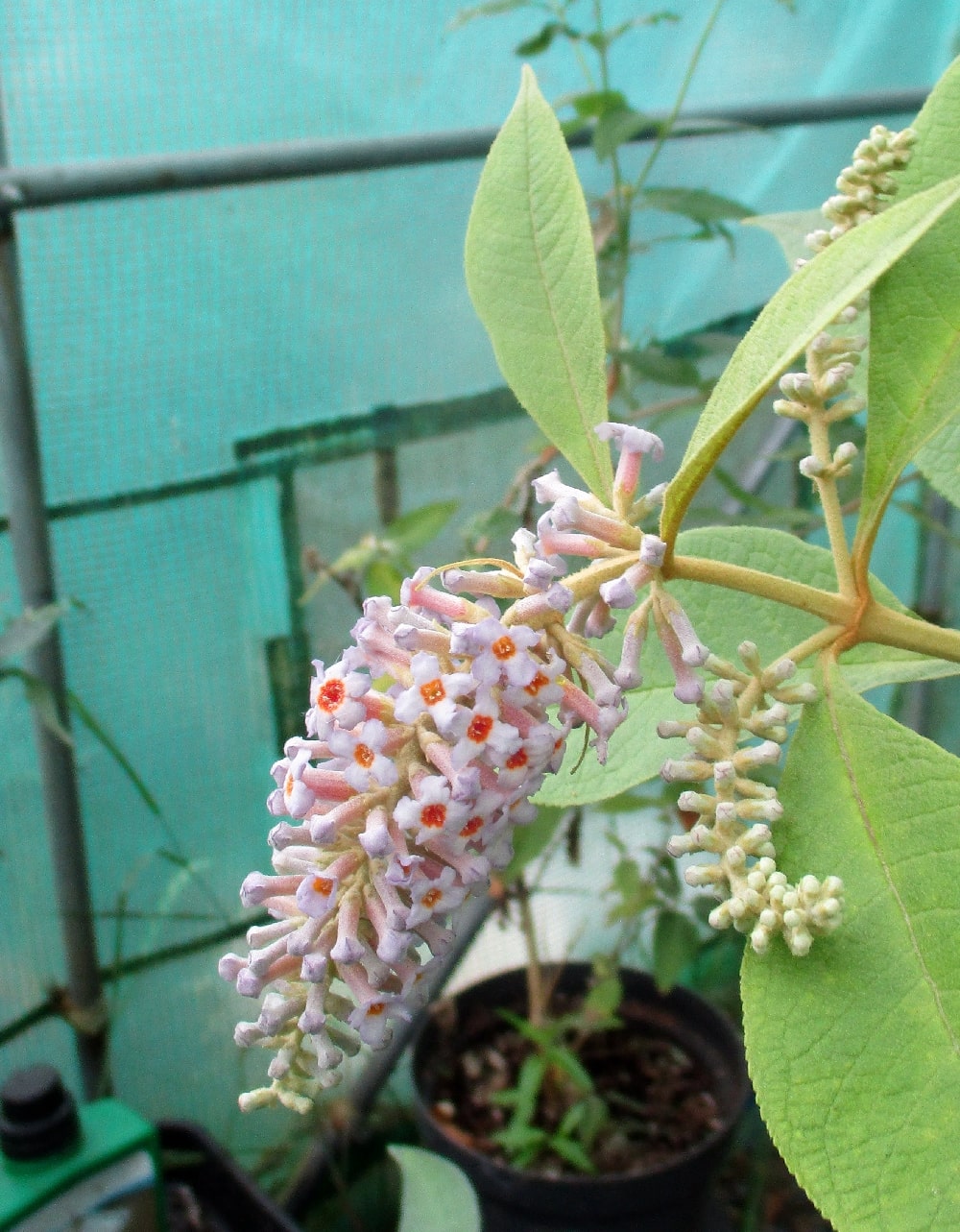
The flower shown is from a B. macrostachya seedling I raised a while back. The photo was taken in August of last year, as it's a summer flowering type. This one has inherited the brown tomentum on the stems and undersides of the leaves from its seed parent. Although the inflorescence is quite small, it's an unusual colour - a pale bluish-lilac. The plant looks to be very hardy, so I'll probably be keeping it. Hopefully, the flower panicles will get larger once it's planted out.

B. macrostachya

A B. macrostachya seedling flowering last summer
Open full size image in a new window


A 'Santana' Sport with
Lime-green Foliage

3rd April 2025

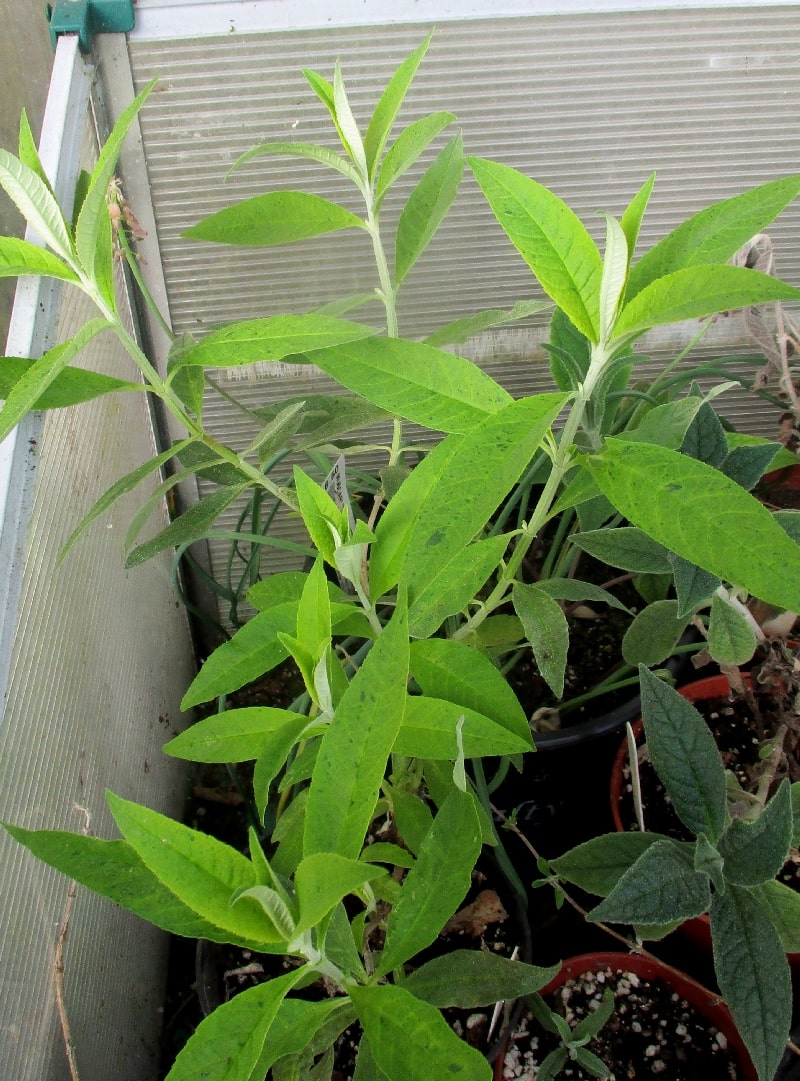
'Santana' is a variegated cultivar; the leaves have green centres with wide yellow margins. It's a sport of 'Royal Red' and has the same deep maroon flowers. My plant is now quite old and behaves erratically: the variegation pattern is quite variable and has a habit of throwing sports. On the plus side, it never reverts to the normal dark green foliage of 'Royal Red'.

I've tried to propagate some of these sports. Several times I've found shoots with all yellow foliage and successfully struck cuttings. But they turned out to be very weak plants and never grew well enough to be worthwhile. They all succumbed to winter, even when kept under cover. This time I found a shoot that was more of a lime-green colour and managed to strike a couple of cuttings. They've survived and are already growing away. When they're bigger I'll plant one outside to test the hardiness.

A similar plant is 'Leela Kapila', which I think must also be a sport of 'Santana' with predominantly yellow leaves. I had this a few years ago but couldn't keep it alive. At the Longstock national collection it remained a very small plant, only a metre tall and much less vigorous than 'Santana', a consequence of the reduced photosynthetic capacity of the yellow leaves.

'Moonshine' is another yellow-leaved cultivar, although that one is perfectly robust and vigorous. It's certainly one worth seeking out if foliage is your thing. I hoping my lime-green sport of 'Santana' will also prove robust as such bright foliage adds year-round interest.
BACK TO TOP


Email:
buddlejagarden@gmail.com


© The Buddleja Garden 2011-2026.